Peloponnese places · Mystras and Sparta
A whole medieval city left standing on a mountain slope, and a calm modern town that is the heir to the most famous warriors in history. What to see, and how to do both in one day.
The short answer
Mystras is a ruined Byzantine city that climbs a hillside above Sparta, with palaces, monasteries and frescoed churches among the ruins. It is a UNESCO World Heritage site, and one of the best-preserved medieval cities in Greece.
Sparta, eight kilometres away, is a quiet provincial town. There is not much left of the ancient warrior city, but it has a good little museum, a statue of Leonidas and some atmospheric ruins on the hill. Together they make a rewarding day.
We run a small hotel on the east coast, a couple of hours to the east, and this is one of the day trips we are asked about most. Here is how we would do it.
Written by the Sampatiki Suites team. Updated September 2026.
Best for
History, frescoes, views
Time needed
A full day for both
The big walk
Up to the castle, uphill
From our coast
About 2 hrs by road
Mystras
The site spreads across a steep slope, and the paths are steep and rocky, so wear proper shoes.
The palace
The grand residence of the Byzantine rulers of the Morea, three storeys tall, with a large audience hall on the top floor. It is the heart of the upper city.
The nuns
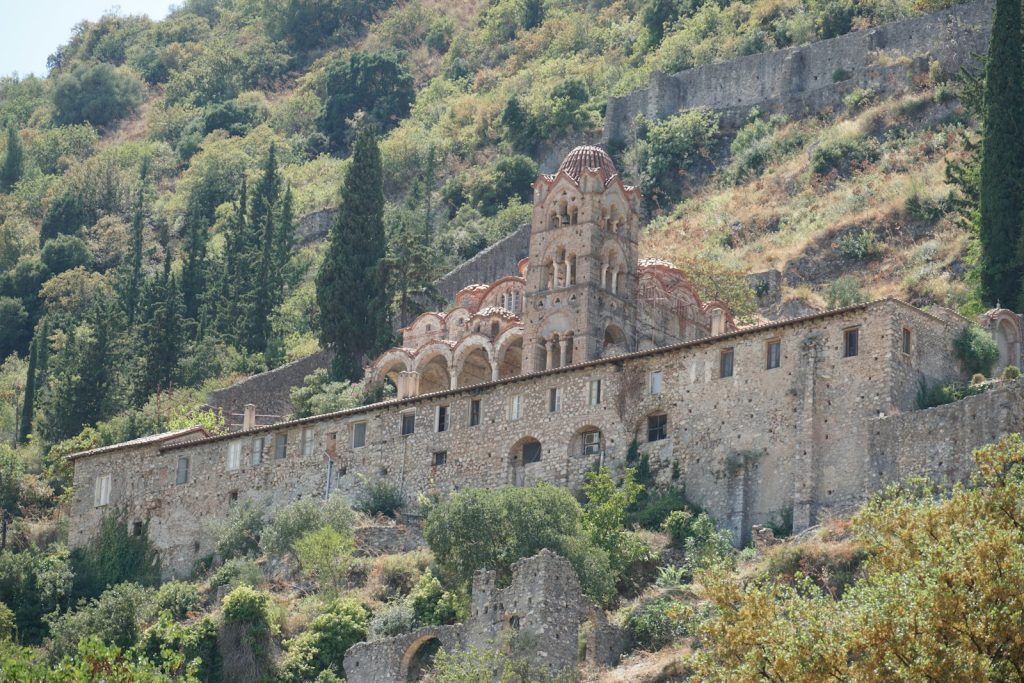
A beautiful monastery that is still home to a community of nuns. It is one of the best-preserved buildings in Mystras, with a fine terrace overlooking the plain.
The frescoes
Mystras has several small churches with painted interiors, including the Peribleptos and the Metropolis, dedicated to Saint Demetrius. The frescoes are among the finest of the late Byzantine period.
The houses
Two early 15th-century houses that show how wealthy families lived, with vaulted lower floors and a feeling of the old city.
The climb
A walk up to the Frankish castle at the summit rewards you with a sweeping view over the Eurotas valley and Sparta, with the Taygetus mountains behind.
The old church
A Byzantine church inside the upper city, once the palace chapel, with views over the roofs.
Our tip
Start at the upper gate, see the castle and palace first while it is cool, then walk down through the lower city.

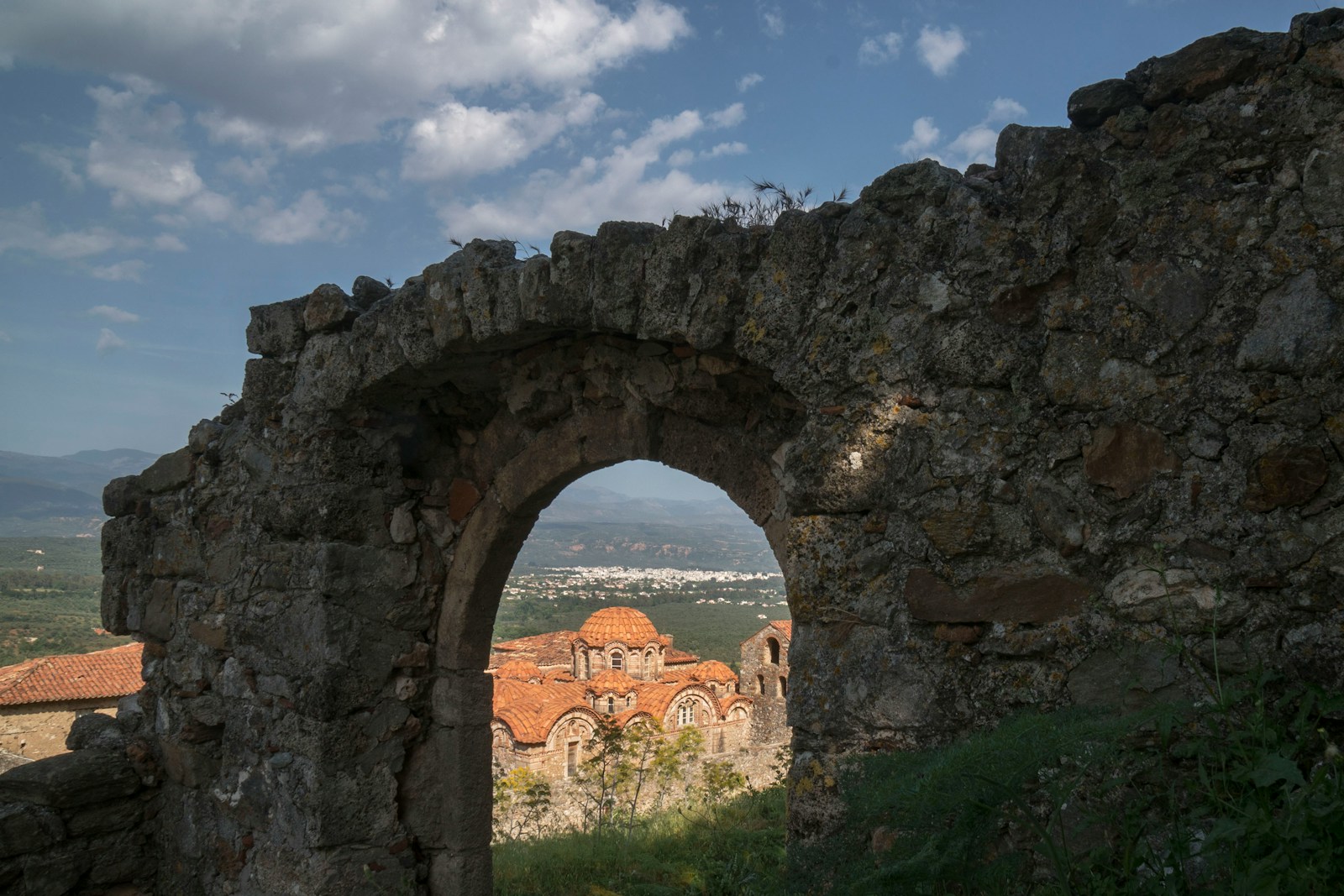
Brick domes and stone walls in the lower city.
A little history
The Frankish prince William II of Villehardouin built a fortress here around 1249. In 1349 the Byzantine emperor made Mystras the seat of the Despotate of the Morea, and for roughly a century it was a centre of art and learning, a late flowering sometimes called the Palaiologan renaissance. The philosopher Plethon taught here, and his ideas travelled to Italy and helped shape the Renaissance.
The Ottomans took the city in 1460. It was slowly abandoned over the following centuries, which is why you now walk through streets, churches and houses that are ruined but still recognisable. It was added to the UNESCO World Heritage list in 1989.
Sparta
The ancient city fell into decline after being sacked in 396 AD, and the people moved up the hill to Mystras. Modern Sparta was laid out again in the 1830s and is a calm, tidy town with wide streets and orange trees.
Do not expect big ruins. Do expect a pleasant afternoon and some good stories.
The statue
A statue of the Spartan king who held the pass at Thermopylae, and a good place for a photograph.
The museum
Sculptures, inscriptions and finds from the ancient city, in a small, calm museum.
The surprise
A well-liked museum that explains how olive oil shaped life in this region, which is why so many people enjoy it.
The hill
Ruins on the hill north of the town centre, with views and, in spring, wildflowers.
Further out
A shrine to Menelaus and Helen east of the town, and the sanctuary of Artemis Orthia, for those who like old stones.
Our tip
Visit Mystras in the morning, have lunch in Sparta and see the museums in the heat of the afternoon.
Mystras and the east coast
From our corner of the east coast it takes about two hours each way, so it makes a full day, best done in spring or autumn. Leave early and be at the Mystras gate when it opens, then spend the afternoon in Sparta.
On a longer trip it also sits neatly between the east coast and the Mani: three or four nights with us for beaches and trails, then Mystras and Sparta, then south.
From us at Sampatiki
Mystras is a full day, so start with breakfast from 07:00 and we can pack a takeaway box. Come back to the pool and the spa in the evening, with dinner nearby.
Keep exploring
Questions
Is Mystras worth visiting?
Yes. It is a ruined Byzantine city with palaces, churches and monasteries on a mountain slope, and a UNESCO World Heritage site.
How long do you need at Mystras?
Allow two to three hours on site, more if you want to climb to the castle at the top and take your time over the churches.
What is Mystras famous for?
Its late Byzantine churches, its frescoes, the Palace of the Despots and its role as the capital of the Despotate of the Morea until 1460.
What is there to see in Sparta?
The Leonidas statue, the Archaeological Museum, the Museum of the Olive and Greek Olive Oil and the ruins of the ancient acropolis and theatre.
Is there anything left of ancient Sparta?
Only a little. The ancient city declined after 396 AD, and what remains is mainly on the acropolis hill, at the sanctuary of Artemis Orthia and at the Menelaion.
What is the best time to visit Mystras?
Spring or early autumn, early in the day. The site is steep and has little shade in summer.
Can you do Mystras and Sparta in one day?
Yes. See Mystras in the morning and Sparta in the afternoon. They are about eight kilometres apart.
How far is Mystras from the east coast?
About two hours from Leonidio by road, so it is best as a full day or on the way to the Mani.
Stay with us
Eleven sea-view suites, a spa and a breakfast built around local produce, a few minutes from Leonidio.